
Not all PPV fans are designed the same, perform the same, or even have the same airflow type. So understanding how your fan works and what its Performance Potential is will help you accomplish your goals- to Pressurize, to Ventilate, or both.
So here’s what you need to know right off the bat: the very best PPV performance you can have is from a huge fan with huge power because it offers a big airstream, big airstream momentum and big entrainment to pressurize and ventilate. But battery-operated PPV fans are built smaller for taking up less space on apparatus and for easy maneuverability. A small fan produces a small airstream, which means that airstream needs to do a little magic for optimal performance. Now not all PPV fans are designed the same, perform the same, or even have the same air flow type. So understanding how your fan works and what its performance potential is will help you accomplish your goals: to pressurize, to ventilate, or even both.
This blog will be broken into the three primary systems of PPV ventilation: System 1 is the Fan Itself, System 2 is the Airstream it generates, and System 3 is Structure. We will look at the variables of each system to understand how they influence the function and performance of the fan.
System 1- The Fan Itself
Creating Momentum and Thrust
The two most important components of fan performance are its Airstream Size and its Power. The way a PPV fan works is that it uses power to accelerate air into the airstream. Now, based on the Airstream Size and the amount of power applied to it, a fan generates a certain amount of Momentum in the airstream. Airstream Size + Power = Momentum. *The amount of Momentum a fan can induce into the airstream defines the performance potential of that airstream.
So, the bigger the airstream and the more power you can put into it, gives you higher momentum and better performance. For example: a small fan that produces a small airstream with a small amount of power gives you low performance because the fan is limited in the amount of Momentum it can induce into that airstream. And the opposite: a big fan that produces a big airstream with a large amount of power gives you high performance. Now, don’t be mistaken, most PPV fans out there on the market today are either large with a limited amount of power, or small with a big amount of power, but both are limited in performance. But aren’t BlowHard fans small with big power? Why yes, they are! However, our expansion airstream allows our fans to perform as though they are much bigger than they actually are!
Click HERE to watch a short video on BlowHard’s High-Flow Expansion Jetstream
PPV fans are firefighting tools and BlowHard believes they should be designed and optimized for that application. But for this article, we’re focusing on PPV Fan Performance Potential regardless of the manufacturer.
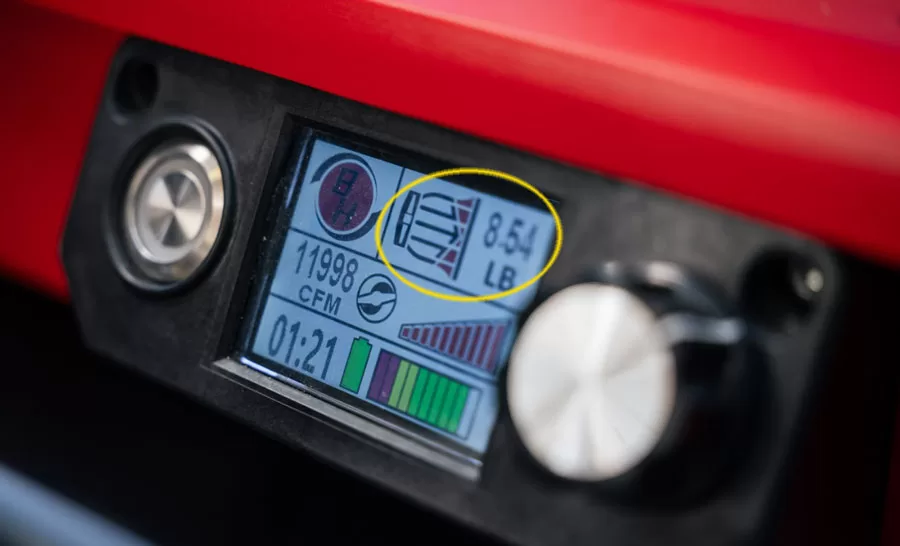
So how does one measure a fan’s airstream potential-its ability to do the work? Well, a direct measurement of the Momentum in an airstream is called Thrust. Thrust, not CFM, is the most accurate method of measurement to determine the performance potential of any fan. Now, you’ve heard the saying “every action has an equal and opposite reaction.” Thrust gives a precise measurement of an airstream’s Momentum because it is the equal and opposite reaction to the Momentum the fan has induced into the airstream. Thrust measures Momentum and it’s Thrust that measures your fan’s performance!
**Because of this important metric, BlowHard displays Thrust levels on the Operator Interface, which updates dynamically as the user increases/decreases power.
Recap of System #1:
The fan itself is the first component in PPV performance, and it creates Momentum in the airstream in response to the fan’s Airstream Size and its Power. There’s a Thrust reaction against the fan in direct response to the Momentum induced into the airstream. *Moving forward, we will refer to Momentum as Thrust.
System 2 – The Airstream
Thrust in the Airstream
Historically, CFM or Volumetric Airflow measured in cubic ft/min has been used to gauge a fan’s performance. Now, CFM is a key component of performance, but it isn’t everything! You’ve got to factor in that airstream’s Velocity or Speed in order to truly define a fan’s performance. You see, Airstream Velocity is actually Airstream Pressure. From System #1, you learned that the fan itself creates Thrust from its Airstream Size + Power, but after air has left the fan, Thrust is now defined by the combination of CFM + Pressure. CFM + Pressure = Thrust. These are the true performance metrics of an airstream!
*You cannot gauge a fan’s performance simply on a CFM number, because many fan have high CFM and no Pressure! You’ve got to factor in both CFM and Pressure in order to know the fan’s true performance!
Airstream States
Battery-operated PPV fans should be small in size to reduce storage requirements on apparatus as well as provide easy portability for reaching more places quickly. However, because of their small size, their airstreams are also small and in a compressed, high-pressure state. That small, compressed state is not an effective usable form when high flow is needed to ventilate a building. In order to get the airstream into a usable, high-flow form, it has to be able to convert into a high-flow or high CFM state. Let’s break this down…
Airstream State #1
is right when it exits the fan and is in a tightly condensed, compressed state: High Pressure/ Low CFM.
Airstream State #2
is anywhere downstream. It’s traveling, entraining air, growing bigger and converting to a state of Low Pressure / High CFM.
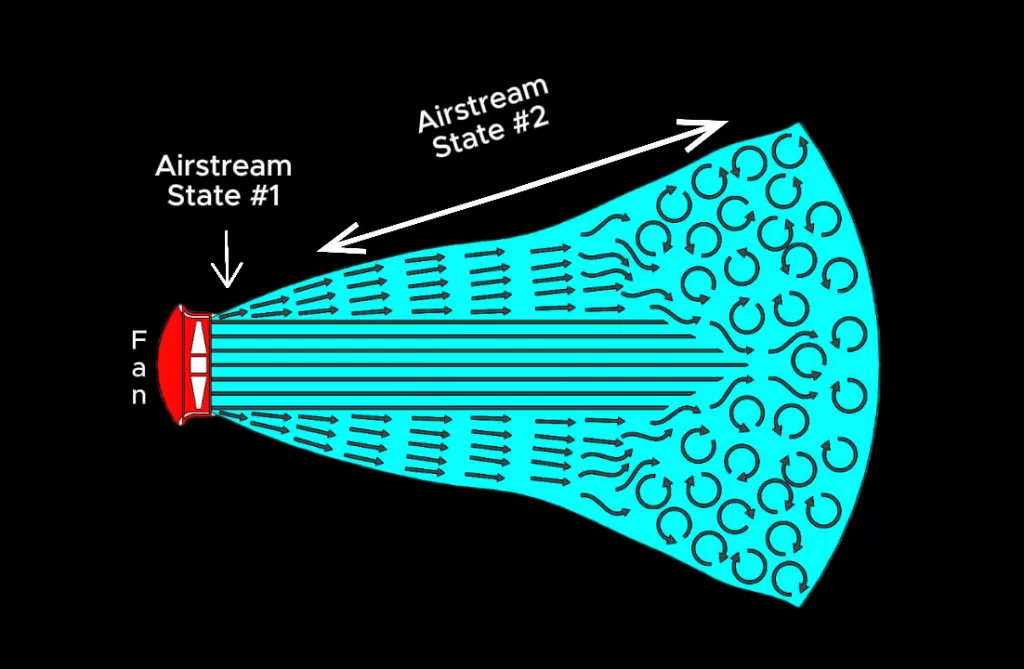
The airstream’s got an important job to do and if it can’t do it, it won’t perform optimally because the state of that airstream will define how airflow works within a structure. So, what is the job the airstream has to do? It’s got to increase CFM through Entrainment, which means as it travels, it pulls air into itself from the surrounding environment. Effective and efficient Entrainment is what allows the airstream to change states as it travels.
Click HERE to watch a short video on Entrainment.
*Fans which generate High-Thrust airstreams (High CFM + High will be capable of Entraining more air to generate higher CFM, but more importantly, will maintain that higher pressure when it gets to its expanded state, which now means it has increased potential to do the work!”
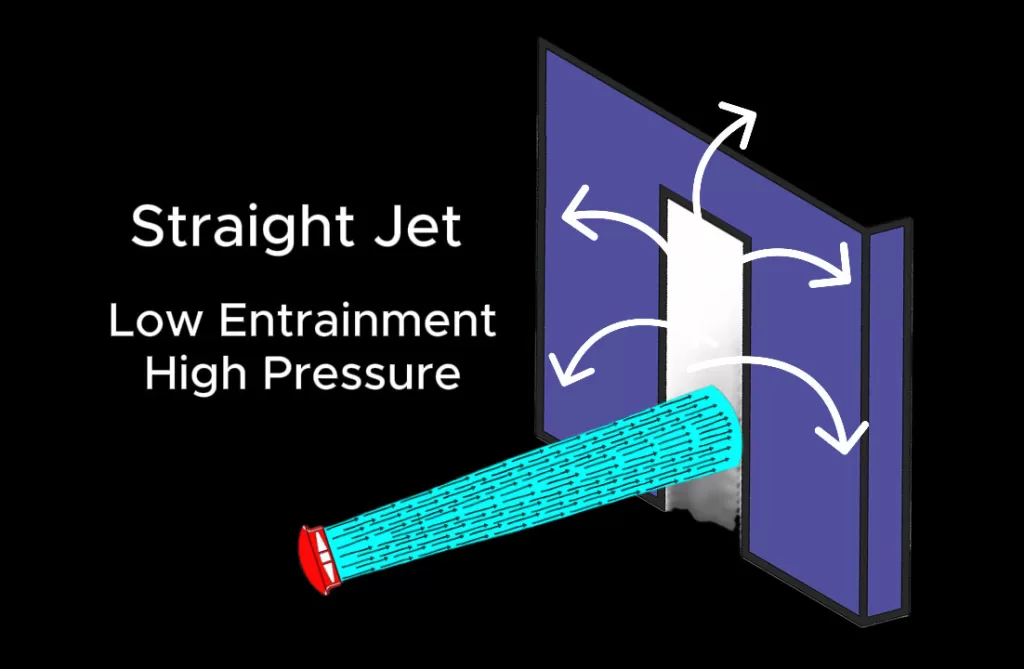
Now, we mentioned “effective and efficient” Entrainment because it’s critical to note that different fan designs produce airstreams with higher or lower rates of Entrainment. Some battery-operated PPV fans have limited Entrainment, like the Straight Jet, because it has difficulty Entraining and gaining CFM by the time it gets to the door:
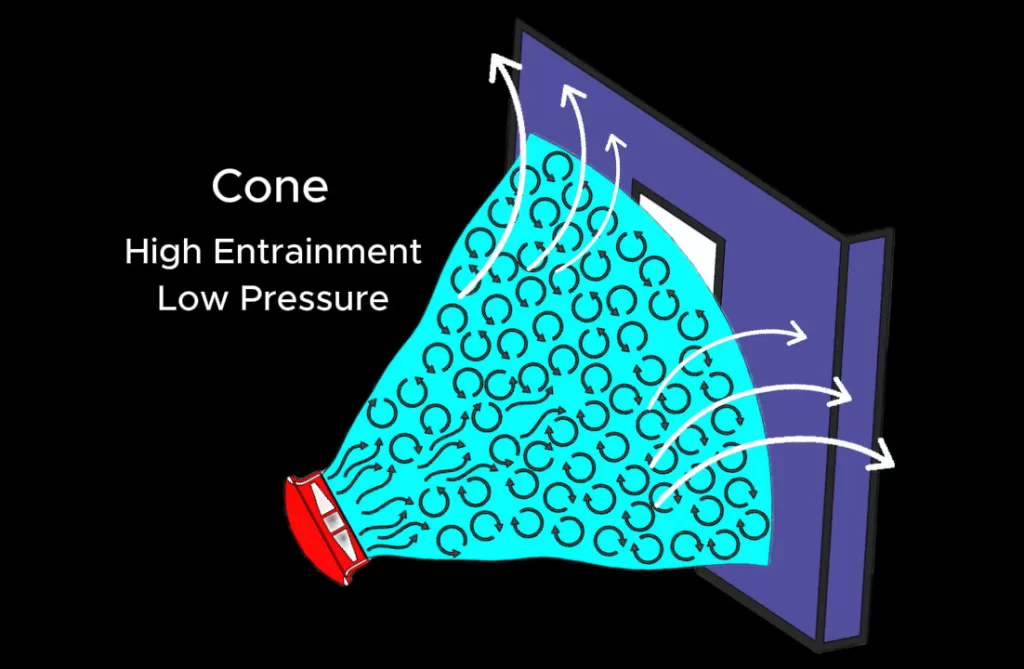
Others utilize modes of Entrainment like the Cone which entrain rapidly, but the wire grills used to create the cone significantly reduces pressure in the airstream:
Click HERE to watch a short video on the Pros and Cons of Airstream Types.
Recap of System #2:
The two primary factors of an airstream are Thrust and Entrainment. Thrust is the driving force within the airstream, and Entrainment allows it to transition to different airstream states.
System No. 3 – The Structure
How to Utilize the Different Airstream States:
Now, every structure and situation are different. Doors are different sizes, buildings are different sizes, and so the Thrust (Pressure and CFM) requirements are also going to be different. In order to generate the best outcome and maximize fan performance relative to the structure, it’s important to understand those situations and to have both the proper fan and proper fan placement. Are you needing to pressurize, to ventilate, or both? A large part of performance is the fan’s ability to seal air into the structure with its airstream. This is accomplished by expanding the airstream to match the size of the door as much as possible to limit the amount of air that can escape.
When using a fan to pressurize or ventilate a structure, you have to also consider both the structure’s inlet and outlet openings and choose the correct airstream state that we discussed.
Airstream State #1
(High Pressure/ Low CFM) is used for increasing pressure in a structure. This is best done with the fan placed closer to the door and outlet openings need to be limited. You would also need an air curtain to contain pressure in the structure and to prevent blowback. An example of high-pressure scenarios is when needing to overpressure a region of a building to prevent smoke from entering and provide an escape route for victims.
Airstream State #2
(Low Pressure/High CFM) is most commonly used to ventilate a structure. This is best practiced with the fan set back from the door to allow the airstream to transition through Entrainment and generate higher CFM. To increase flow through the structure, outlet openings need to be added. Examples requiring high CFM are clearing smoke for visibility, providing fresh air, and cooling down the structure. Now, some circumstances require both pressurizing and high flow, like clearing smoke for visibility in larger and taller structures with restricted exit points, and for PPA attack. These cases require a bigger fan with high power for extreme performance.
Summary
Fans with large airstreams and high power will produce high Thrust within their airstreams. High Thrust will lead to an increased rate of Entrainment which in turn leads to the airstream’s ability to convert into a usable form. You can utilize the airstream’s high-pressure state for pressurizing a building or use its high CFM state for ventilation. Fan performance is highly influenced by fan design, size, power, entrainment ability, how you set up your fan, and the configuration of the structure.
That was a lot of information but still just skimmed the surface of PPV fan performance. To see this information in video form, click here
Please reach out if you have any questions or want more information or clarification. info@blowhardfans.com
